
Required

Why Some Fears Don’t Make Sense
Why Some Fears Don’t Make Sense (But Feel Completely Real)
You know your fear doesn’t make any sense. It’s not rational. But the overwhelming thoughts and feelings that come with it feel very real.
If a fear doesn’t seem to make sense, it’s usually not about the situation itself, it’s about how your mind has learned to respond to it.
Whatever thing your phobia and fear is linked to, it can bring on worry, anxiety and panic.
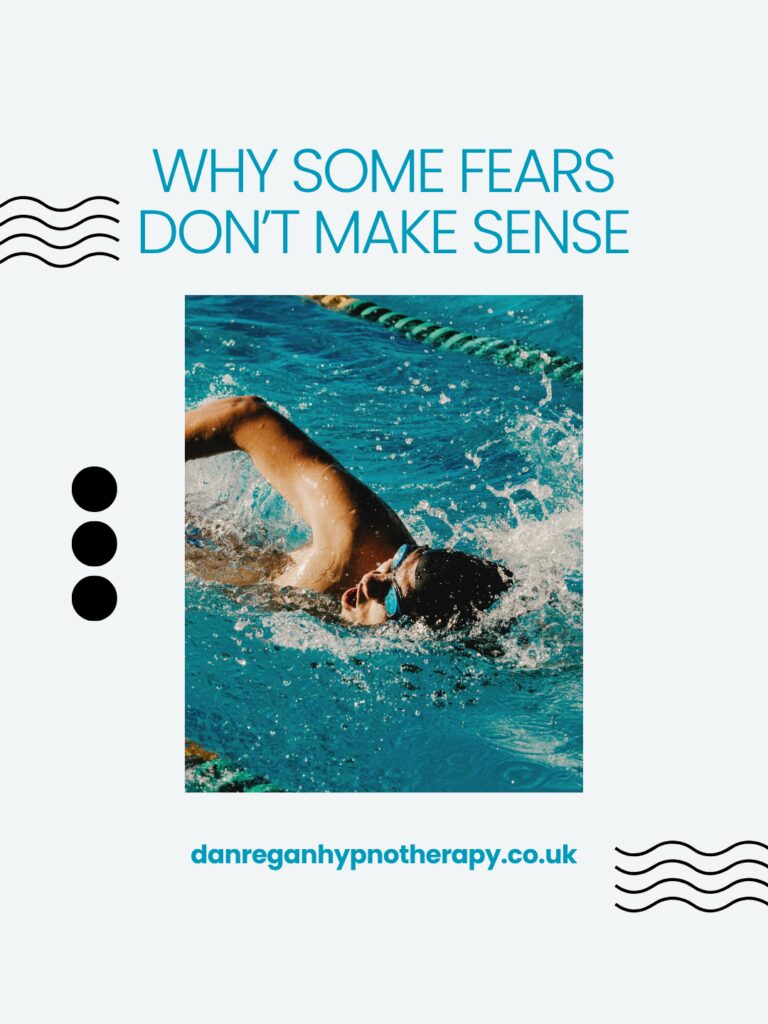
For example, the fear of swimming is a common anxiety that I help clients in Ely to tackle.
You might find yourself avoiding going to the pool when you know it isn’t logically dangerous.
It could be:
- a swimming pool
- a particular detail, like a drain or deep area
- the idea of not knowing what’s beneath you
Part of you knows it shouldn’t feel like a threat.
But another part reacts very strongly with anxiety and panic.
This is how many phobias work, they don’t need to make sense to feel real. And knowing logically that you are safe is not enough to prevent the same overwhelming discomfort that seems to happen automatically.
When Fear Starts to Affect Everyday Life
Many people experience fears or phobias that don’t seem to make sense logically.
For some people, their phobia and fear gradually expands. What starts as dislike or discomfort can become:
- avoiding swimming altogether
- avoiding holidays
- avoiding situations where the fear might come up
In some cases, it begins to affect family life or activities with children.
The brain is designed to prioritise safety, not logic. Once something is linked to a feeling of danger, the emotional response can override rational thinking.
I’ve helped people to tackle their fear around open water swimming. However, the fear of swimming anxiety can also affect people in the pool, even where there is a life guard and they can reach the side or touch the floor if needed.
Fear of Swimming Anxiety: A Recent Example
In my work as an anxiety therapist in Ely, I recently worked with someone who had developed a very specific fear of swimming pool drains.
Over time, the fear had become so strong that they were:
- unable to take their child swimming
- avoiding pools altogether
- reluctant to book holidays
Even though they understood logically that there was no real danger, the feeling of panic was very real.
People often describe their phobia as being ‘silly’ (even thought it’s just how the mind works) and can find they make excuses rather than tell others about their fear.
Why This Happens
Whilst some know, many people don’t know how their fear developed. It can just feel like it has always been there. At some point, it became a problem they couldn’t shift.
Fears like this are often linked to how the mind responds to anxiety and uncertainty.
When something feels:
- unfamiliar
- unpredictable
- slightly out of control
…the brain can treat it as a potential threat.
The body then reacts quickly, creating:
- tension
- heightened awareness
- a strong urge to avoid
The anxiety cycle develops. Before a situation there are the ‘what if’ thoughts, dread and thinking the worst. In a situation, the fear and panic sets in. Afterwards you can feel frustrated about how you felt.
How the Pattern Develops
A common pattern looks like this:
- You notice something that feels uncomfortable
- Your attention focuses on it
- The feeling of unease increases
- You avoid the situation
- The brain learns: ‘this is something to stay away from’
Over time, the fear becomes stronger, even if nothing has actually happened.
This is similar to how anxiety patterns develop.
You may try to force yourself to face your fear, hoping that will help. Instead, the panic and fear association only seems to repeat and even strengthen.
The effort involved in trying to overcome your fear can feel exhausting and futile. It’s only when you need to tackle it that you finally seek help and support.
Overcoming Fear of Swimming Anxiety
Over a number of sessions, we worked on helping this pattern shift.
The focus wasn’t on forcing anything, but on:
- reducing the intensity of the response
- changing how the situation was processed
- gradually rebuilding confidence
As this happened, their experience began to change.
Following their hypnotherapy sessions, they were able to:
- visit thermal pools without worry
- go swimming again
- book a holiday without hesitation
Even more notably, they described their rational thinking beginning to override the initial feeling of panic.
In their words,
“I used to have an unusual phobia of swimming pool drains, it got so bad that I couldn’t take my son swimming, use the pool for exercise, or even book a holiday for fear of the unknown.
I went to see Dan for a free consultation and felt zero pressure. I’m now about to have my ninth and final session, and the results are great. I’ve visited thermal pools in Poland without a worry and just booked a holiday to Egypt without a second thought! I’ve even been swimming twice this week in the ‘drain lane.’ While I’m still a little cautious, my rational brain now overrides any worry, replacing the sheer panic I used to feel. I’m grateful to Dan and so glad I did this.”
Why This Is Important
This kind of change shows something important:
The fear itself isn’t fixed
It’s a pattern, and patterns can change.
In the same way you inadvertently learned the fear response, you can deliberately change your response so you feel calm, confident and in control.
It’s important to know that fears like this are more common than many people realise, and they can change.
How This Links to Anxiety
This is closely connected to anxiety and overthinking patterns.
Phobias also become a habitual pattern of thoughts, feelings and behaviours.
It’s more to do with what goes on inside your head than the thing outside of you. That’s good news because it means you can change how you respond
You may also want to take a look at some of my other article about fear of swimming anxiety:
Anxiety and Fear in The Swimming Pool
Overcoming The Fear of Swimming in Open Water
Fear of Deep Water and Fear of Swimming
A Different Way to Look at It
Instead of asking:
“Why do I feel like this?”
It can help to ask:
“What is my mind reacting to here?”
This often shifts the focus from the object of fear to the pattern behind it.
It’s not about the ‘thing’, it’s about the thoughts and feelings and how you are doing things inside your head.
If You’d Like Support
If you’ve been avoiding something because of a fear that doesn’t fully make sense, it’s important to know that this is something that can change.
Fears don’t need to be logical to feel real. But they also don’t have to stay the same.
If anxiety or a specific fear is affecting your day-to-day life, support is available.
A free initial consultation is there simply to talk things through and see what might help, without pressure or expectation.
To your health and happiness,
Dan Regan
Anxiety Therapy and Hypnotherapy in Ely and Newmarket
Fears and Phobias Hypnotherapy in Ely: Phobia Hypnotherapy
Could you use some help with your anxiety? Struggling with anxiety, stress, worry and fear and need some help? Find out how I can help with a Free Initial Consultation. Learn more here: Appointments
Find out what hundreds of other people have said after their anxiety hypnotherapy sessions with Dan: Hypnotherapy Testimonials
And check out these popular and powerful hypnosis downloads that can start helping you right away with anxiety, confidence and more: Hypnosis Downloads
Get Your Copy Right Now…
Subscribe to Dan’s Digest filled with tips, strategies and techniques and get instant access to your free rapid relaxation hypnosis audio track.
Enjoy feeling and being more mentally calm and physically relaxed right now:

0 Comments