
Required

OCD and Anxiety
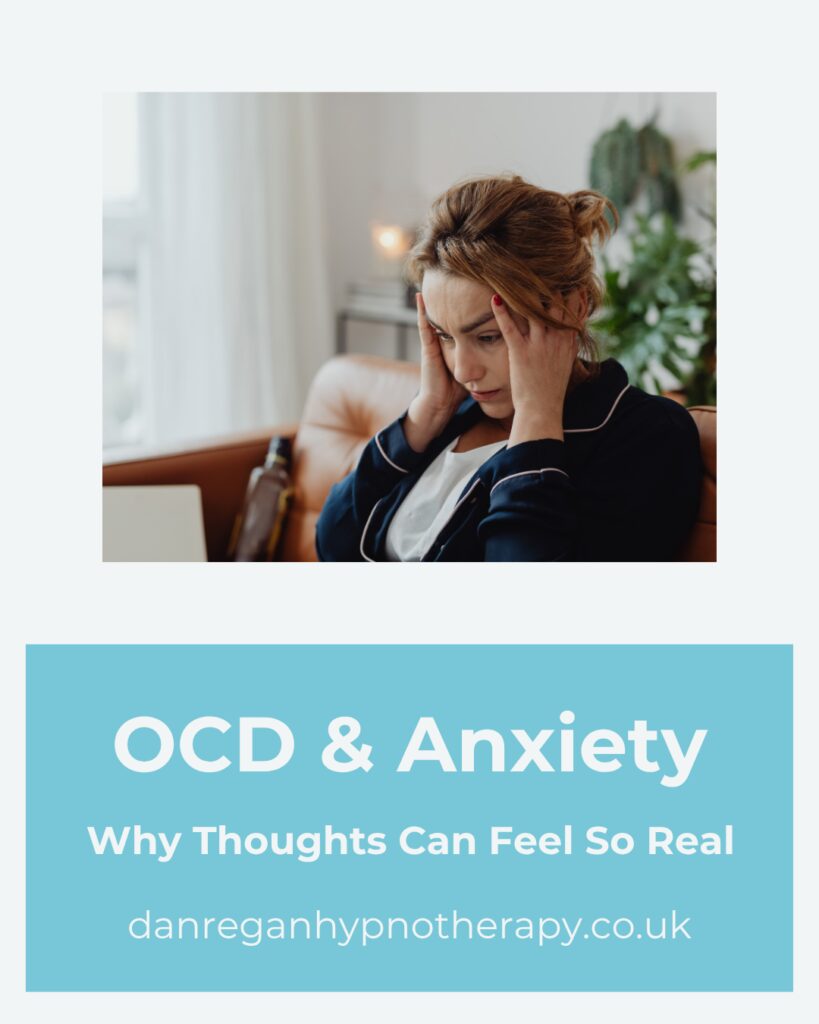
OCD and Anxiety: Why Thoughts Can Feel So Real (And So Difficult to Ignore)
OCD and anxiety can make your thoughts feel very real – and very difficult to ignore. Your thoughts scare you because of what you are imagining. That anxiety leads to more intrusive thoughts. You start to doubt what you’ve done or worry about what you could do.
You might find yourself having thoughts that feel completely out of character.
They may be:
- intrusive
- repetitive
- difficult to ignore
- upsetting or confusing
And often, the more you try to push them away, the stronger they seem to come back.
They may be about harming yourself or others. Your thoughts mess with your recollection of events and what may have happened. You worry why you are thinking such intrusive thoughts and what that means about you and what you are capable of. Your own thoughts scare you.
Sometimes it can lead you to do certain repetitive behaviours to bring some temporary relief. Other times it can all be about that ongoing cycle of intrusive thoughts that torment you inside your own mind.
OCD and anxiety can feel very real – and often quite frightening.
It’s something many people experience, even if they don’t talk about it openly.
If you’re experiencing OCD or intrusive thoughts, it’s usually not the thought itself that’s the problem, it’s the way the mind responds to it, trying to analyse, resolve, or feel certain.
Quick Summary
OCD and anxiety can make intrusive thoughts feel frighteningly real, even when they go completely against who you are.
In this article you’ll discover:
- why intrusive thoughts happen
- why OCD makes certain thoughts feel so important
- why trying to get certainty often keeps the cycle going
- why your thoughts don’t define who you are
- how people begin breaking the OCD and anxiety cycle
Intrusive thoughts feel powerful because of the way anxiety responds to them, not because they reveal anything about your character.
Related Articles
- Anxiety Support Hub
- Intrusive Thoughts and Anxiety
- Anxiety and Overthinking
- Why Anxiety Isn’t Going Away On Its Own
- Physical Anxiety Symptoms
- High Functioning Anxiety
- Hypnotherapy Reviews in Ely
OCD and Anxiety: What Is Happening
If you’re dealing with OCD or anxiety related intrusive thoughts, it’s not about the content of the thought. Most people experience unwanted or intrusive thoughts from time to time. The difference with OCD isn’t the thought itself—it’s the importance your mind gives it and the anxiety that follows.
It’s about how the mind is responding to it.
When a thought creates anxiety, it feels important, threatening, or unusual, the brain tries to:
- analyse it
- make sense of it
- check whether it means something
- resolve uncertainty
This creates a loop.
Your anxious thoughts create anxious feelings. Those feelings lead you to think about it even more.
With OCD and anxiety, you notice that certain thoughts feel much more real, important, or difficult to ignore.
One Thing I’ve Learned About OCD
One thing I’ve noticed over the years is that people with intrusive thoughts are often some of the kindest, most conscientious people I meet.
They’re horrified by the thoughts they’re having and they worry that thinking something somehow means they’re capable of doing it.
They’ll often say things like:
- “What sort of person thinks something like that?”
- “Does this mean there’s something wrong with me?”
In reality, it’s almost the opposite.
The fact those thoughts upset you so much usually tells me they go completely against your values.
OCD isn’t revealing who you really are. It’s exploiting the very things you care about most.
Once people understand that, the thoughts often become far less frightening.
Common OCD Behaviours
People often think OCD is only about washing hands or checking locks.
In reality, compulsive behaviours can take many forms. Their purpose is usually the same – to reduce anxiety or create a sense of certainty.
Some common examples include:
- repeatedly checking doors, appliances or locks
- seeking reassurance from other people
- mentally replaying events to make sure nothing bad happened
- repeatedly researching symptoms or fears online
- counting, repeating or carrying out routines that temporarily reduce anxiety
- avoiding situations that trigger intrusive thoughts
Although these behaviours may bring relief for a short time, they often teach the brain that the thought was genuinely dangerous.
As a result, the anxiety returns and the cycle continues.
Why Thoughts Feel So Real
One of the most difficult parts is how convincing these thoughts can feel.
That’s because:
- attention increases their intensity
- emotional response makes them feel significant
- repetition makes them feel important
The mind starts treating the thought as something that needs solving.
For example, someone might have a sudden intrusive thought and then spend hours trying to work out what it means or whether it says something about them. Even if they logically know it doesn’t, the feeling of uncertainty keeps the thought active.
You scare yourself in your own focus and imagination.
You may find yourself checking, asking for reassurance, replaying events in your mind or carrying out certain routines because they briefly reduce the anxiety. Unfortunately, that temporary relief teaches the brain to keep the cycle going.
As with many forms of anxiety, logic often becomes overshadowed by fear and uncertainty. Everything becomes about the intrusive thoughts and anxiety.
Why OCD Keeps Going
- A thought appears
- It creates anxiety
- The mind tries to analyse or seek certainty
- You feel temporary relief
- The brain treats the thought as important
- It returns again.
This loop is what keeps the experience going.
A Common Experience: OCD and Anxiety in Ely
In my work as an anxiety therapist in Ely, people often describe noticing a thought and then becoming stuck on it.
For example:
Someone may have a sudden intrusive thought and then begin questioning:
- “Why did I think that?”
- “What does that mean about me?”
- “What if this is true?”
The more they try to resolve it, the more the thought returns.
It can involve harm to yourself or others and can lead to checking, overthinking or carrying out repetitive behaviours.
At times, you may feel that you have become trapped by your own OCD and anxiety thoughts.
Why Trying to ‘Get Rid of the Thought’ Doesn’t Work
A natural response to intrusive thoughts is to:
- push the thought away
- try to replace it
- look for reassurance
- carry out checking or certain actions to appease it
But this often strengthens the cycle.
Because the mind learns: “This thought is important”
The same pattern repeats over and over.
The Role of Anxiety
OCD and intrusive thoughts are closely linked to anxiety.
When the mind is slightly on edge, it becomes more:
- alert
- focused on potential threats
- sensitive to uncertainty
You can read more about how anxiety works on my anxiety hub page.
What Actually Helps
What actually helps with OCD and anxiety?
1️⃣ Understanding the Pattern
The first step is recognising that this is a pattern – not a reflection of who you are.
Everyone has intrusive and unpleasant thoughts. Thinking something does not make it a fact and isn’t a reflection of who you are.
Thoughts can feel powerful without being meaningful.
2️⃣ Changing How You Respond
Instead of trying to eliminate or analyse the thought, it can help to:
- notice it
- allow it to be there
- avoid analysing or engaging
It’s an anxious interpretation of a passing thought, rather than evidence that the thought means anything about you.
3️⃣ Reducing the Need for Certainty
A lot of the cycle is driven by wanting to feel sure.
Learning to tolerate uncertainty reduces the intensity.
Learn to calm your anxious feelings so you can think more clearly and be comfortable with not needing to act on a thought.
You may also find it helpful to read more about how to build confidence and self-esteem.
4️⃣ Breaking the Analysis Loop
Repeated thinking keeps the cycle going.
Gently stepping back from analysing helps reduce it over time.
You don’t need to analyse or overthink about a random, imagined thought (no matter what it’s about).
5️⃣ Understanding Thoughts Are Not Facts
Just because something feels real does not mean it is true.
This can take practice, but it is a key shift.
You do this with many other thoughts that cross your mind.
The content and nature of OCD thoughts causes distress. However, it is still not a fact.
Experiencing these kinds of thoughts does not mean anything about you as a person, even though it can feel that way at the time.
The Good News
One of the biggest misconceptions about OCD is that people believe they have to stop the thoughts.
In reality, recovery isn’t about never having another intrusive thought.
It’s about changing how you respond when one appears.
Once the thoughts lose their emotional impact, they usually become far less frequent and much easier to dismiss.
Many people are surprised how quickly this begins happening once they understand the pattern.
How This Links to Other Patterns
This often overlaps with:
If You’d Like Support in Ely and Newmarket
In my work as an anxiety therapist in Ely, this is something I see regularly, and it is often much more common than people realise.
If you’ve been experiencing intrusive thoughts or OCD related patterns, it’s important to know that this is something that can change.
Thoughts can feel very real, but they don’t have to control how you feel or respond. Many people who once believed these thoughts would always control them eventually find they lose much of their power.
If anxiety, intrusive thoughts or OCD patterns are affecting your day-to-day life, support is available.
A free initial consultation is there simply to talk things through and see what might help, without pressure or expectation.
To your health and happiness,
Dan Regan
Anxiety Therapy and Hypnotherapy in Ely and Newmarket
Anxiety Therapy and Hypnotherapy in Ely: Anxiety Therapy
Could you use some help with your anxiety? Struggling with anxiety, stress, worry and fear and need some help? Find out how I can help with a Free Initial Consultation. Learn more here: Appointments
Find out what hundreds of other people have said after their anxiety hypnotherapy sessions with Dan: Hypnotherapy Testimonials
And check out these popular and powerful hypnosis downloads that can start helping you right away with anxiety, confidence and more: Hypnosis Downloads
Get Your Copy Right Now…
Subscribe to Dan’s Digest filled with tips, strategies and techniques and get instant access to your free rapid relaxation hypnosis audio track.
Enjoy feeling and being more mentally calm and physically relaxed right now:



0 Comments